TLDR
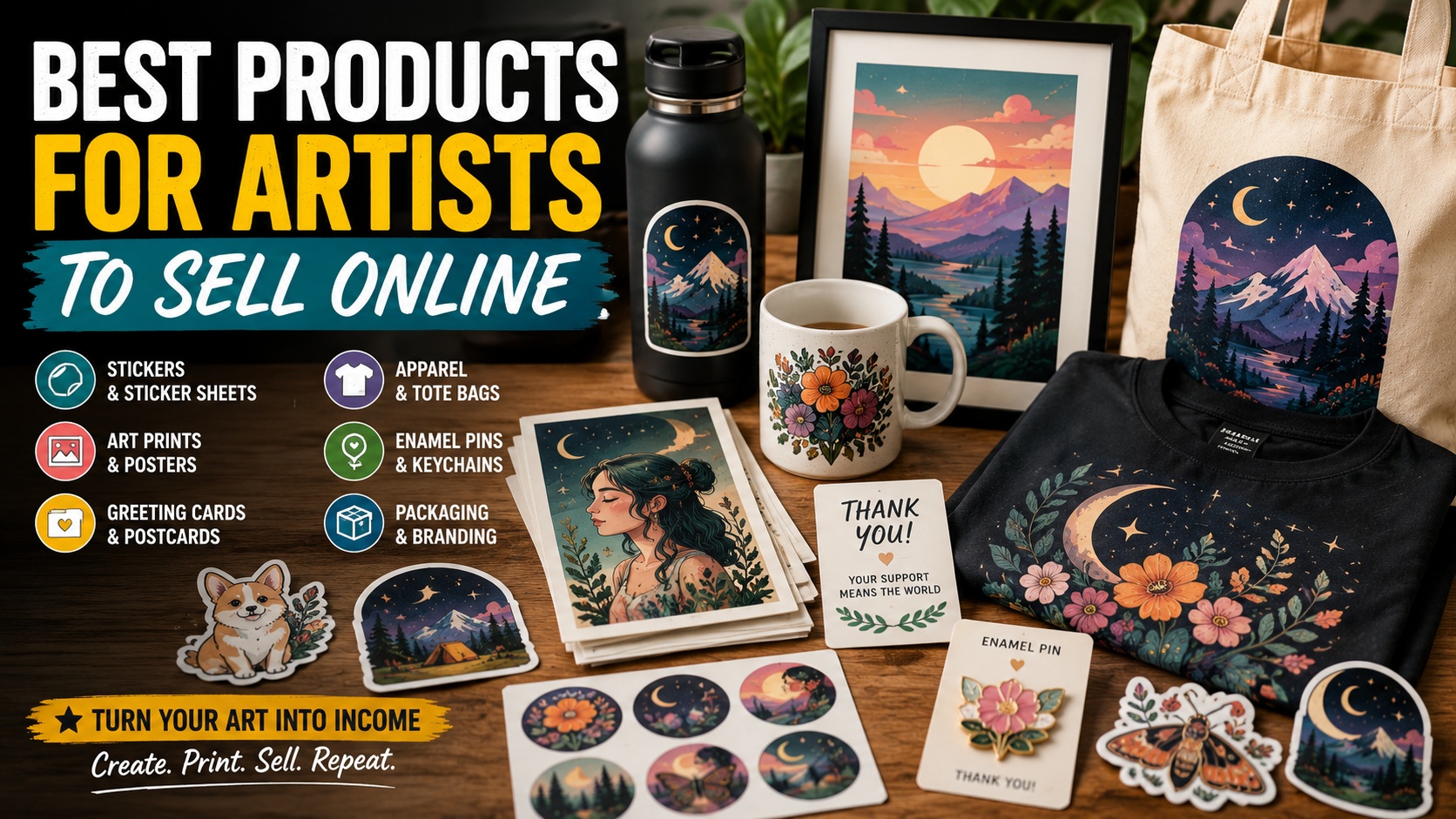
The best products for artists to sell online are usually small, easy to ship, visually clear, and simple to restock.
Stickers, sticker sheets, art prints, greeting cards, apparel transfers, mini prints, and branded packaging inserts are strong starting points because they let artists turn existing work into sellable products without building a huge inventory system.
Start with a focused product line, test small batches, take clear photos, and price for materials, packaging, fees, and your time.
Introduction
A good online art product does not have to be large or expensive. Sometimes the easiest item to sell is a $4 sticker, a small print, or a greeting card that helps someone support your work without making a big purchase.
That is why choosing the best products for artists to sell online matters. The right product makes your art easier to buy, easier to ship, and easier to reorder. The wrong product can leave you with slow-moving inventory, awkward packaging, and a closet full of boxes you quietly regret ordering.
Artists have more options than ever: stickers, prints, sticker sheets, cards, apparel, tote bags, pins, digital downloads, zines, labels, and limited merch drops. But more options do not always make the decision easier. A product should fit your art style, your audience, your budget, and your ability to fulfill orders consistently.
Here are the best online products for artists, plus how to decide which ones are worth testing first.
What Makes a Good Product for an Online Art Shop?
A strong product for an artist usually checks a few boxes.
It should be easy to understand from a photo. It should ship safely without costing more than the product itself. It should have enough margin to be worth packing. And it should feel connected to your art, not like random merch with your design slapped onto it.
For most artists, good products have these traits:
- low to moderate production cost
- clear visual appeal
- simple packaging
- easy storage
- repeat purchase potential
- giftable format
- strong product photos
- room for bundles or collections
The best product is not always the one with the highest price. A large framed print may sell for more, but it can be harder to store and ship. A sticker pack may sell for less, but it is easy to mail and easy for customers to add to another order.
That is the tradeoff. Artists usually need a mix of small impulse-buy products and higher-value pieces.
Stickers Are One of the Best Starter Products
Stickers are often the easiest first product for artists to sell online.
They are small, light, affordable to ship, and easy to collect. They work well for illustrators, tattoo artists, cartoonists, lettering artists, painters, graphic designers, photographers, and anyone with bold visual work.
Good sticker designs usually have:
- a clear subject
- strong shape
- readable details
- clean edges
- good contrast
- a size that fits laptops, bottles, journals, and cases
For artists turning finished drawings or digital illustrations into merch, custom artwork stickers are a practical starting point. A single character, flower, animal, skull, phrase, logo, or icon can become a product without needing a full collection right away.
Stickers also make good add-ons. A customer who is not ready to buy a $30 print may still buy a few stickers. That matters because lower-priced products can help new customers enter your shop.
You can sell stickers as:
- singles
- three-packs
- mystery packs
- seasonal drops
- freebies with larger orders
- limited edition designs
- convention or market exclusives
The main mistake is making stickers too small or too detailed. If a design depends on tiny linework, small lettering, or subtle texture, print a test at actual size before ordering.
Sticker Sheets Work Well for Collections
Sticker sheets are different from single stickers because the whole sheet becomes the product.
They are a good fit for artists who draw small icons, characters, decorative elements, planner stickers, stationery designs, or themed sets. A sheet lets you include several designs in one product, which can feel more complete than selling tiny stickers one by one.
Sticker sheets work especially well for:
- journaling
- planners
- scrapbooks
- stationery shops
- character sets
- cute food art
- botanical art
- mini animals
- fantasy objects
- seasonal themes
If your art style includes lots of small pieces, custom sticker sheets can help turn those smaller drawings into a clean, sellable product. One sheet might include a main character, small stars, speech bubbles, flowers, icons, and a few decorative shapes.
The trick is to design the sheet as a whole. Do not just place random art on a page. Use a consistent color palette, spacing, and theme so the sheet feels intentional.
A sticker sheet can also increase order value. Instead of buying one $3 sticker, a customer may buy one $10 or $12 sheet.
Art Prints Give Detailed Work Room to Breathe
Art prints are one of the most natural products for artists to sell online.
They work best for finished pieces with enough detail, composition, and mood to be displayed. Digital paintings, photography, fan-free original illustrations, typography posters, landscapes, character art, abstract work, and editorial-style art can all make strong prints.
Common sizes include:
| Print Size | Best For |
|---|---|
| 5×7 | Small gifts, bundles, affordable prints |
| 8×10 | Easy framing, popular online shop size |
| 11×14 | Statement pieces, detailed illustrations |
| 12×18 | Posters, bold graphic designs |
| 16×20 | Higher-value prints and wall art |
For artists who want a clean physical version of their work, custom art prints are a logical step after stickers. Prints let detailed artwork stay detailed, which is not always possible on a small sticker.
Pay attention to aspect ratio. A square piece may not fit an 8×10 print without cropping. A vertical digital painting may need a border. A horizontal illustration may work better as a poster than a standard frame size.
Prints also need better packaging than stickers. Use sleeves, backing boards, rigid mailers, or tubes depending on the size. Damaged corners are not a charming handmade detail. They are just damaged corners.
Greeting Cards and Postcards Are Easy to Gift
Greeting cards and postcards are useful because they give customers a reason to buy art for someone else.
A print is often personal. A card is shareable.
Cards work well for artists who make:
- floral illustrations
- cute animals
- hand lettering
- holiday art
- birthday designs
- thank-you art
- wedding or love themes
- funny phrases
- local landmark art
- seasonal collections
Cards can also be bundled. A set of four botanical cards, six holiday cards, or three thank-you cards can make a simple product feel more substantial.
Postcards are even simpler. They can be sold as mini prints, mailed as actual cards, or included as package inserts. A postcard version of a popular print can become an easy lower-priced product.
Greeting cards and postcards are especially useful if your audience buys gifts. If your art already gets comments like “this would be cute for my friend,” that may be your sign.
Apparel Transfers Can Turn Art Into Wearable Merch
Apparel can be great for artists, but it takes more planning than stickers or prints.
Shirts, hoodies, and tote bags require decisions about garment colors, sizing, placement, inventory, washing, and fulfillment. That does not mean artists should avoid apparel. It just means apparel works best when the design is strong enough to carry the product.
Good apparel designs tend to be:
- bold
- readable from a distance
- simple enough for fabric
- shaped well for a shirt or tote
- connected to a community, phrase, character, or visual identity
A highly detailed digital painting may look better as a print. A bold character, mascot, logo, or phrase may work better on a shirt.
For small merch drops, custom DTF transfers can be useful because they let artists press full-color designs onto shirts, hoodies, and totes without committing to a large printed apparel inventory too early.
A smart first test could be one shirt design in a few sizes, or one tote bag design based on your most recognizable artwork. Keep the first apparel drop simple. Apparel gets complicated fast when every design comes in five colors and seven sizes.
Mini Prints and Small Bundles Are Great for Lower Price Points
Not every customer wants a large print. Mini prints give people a way to buy art without spending as much or needing wall space.
Mini prints can be sold as:
- 4×6 prints
- 5×7 prints
- small postcard prints
- themed print packs
- convention exclusives
- thank-you inserts
- mystery bundles
Small bundles are especially useful for artists with a lot of related work. A “forest creatures” bundle might include two stickers, one mini print, and one postcard. A “coffee shop” bundle could include a sticker sheet, a small print, and a greeting card.
Bundles make your shop easier to browse. They also help customers who like your work but do not want to choose every item individually.
A good bundle should feel curated. Three random leftover products in a bag is not the same thing.
Branded Packaging Inserts Can Support Repeat Sales
Packaging inserts are not usually the main product, but they can help artists sell more over time.
A buyer may find your art on Etsy, Instagram, TikTok, a market, or a convention table. Once they order, your packaging is one of the best chances to bring them back.
Useful inserts include:
- business cards
- thank-you cards
- care cards
- QR code cards
- small flyers
- coupon cards
- collection cards
- freebie stickers
These pieces work best when they match your brand. Use the same logo, colors, and tone across the card, packaging sticker, and online shop.
CustomStickers.com offers other print products for small brands, including art prints, business cards, flyers, greeting cards, and DTF transfers. For artists, that can help keep shop materials, package inserts, and product drops visually consistent.
Do not overload the package with paper. One useful card is better than five inserts the customer immediately recycles.
How to Match Products to Your Art Style
Some products fit certain art styles better than others.
| Art Style | Good Product Options |
|---|---|
| Bold characters | Stickers, shirts, sticker packs, acrylic-style merch |
| Detailed digital paintings | Art prints, posters, mini prints |
| Hand lettering | Stickers, cards, shirts, tote bags |
| Small icons | Sticker sheets, planner stickers, stationery |
| Photography | Art prints, postcards, calendars |
| Cute animals | Stickers, cards, sticker sheets, gift bundles |
| Tattoo-style flash | Sticker sheets, art prints, flash cards |
| Botanical art | Prints, greeting cards, packaging stickers |
| Comic art | Zines, sticker packs, prints, character merch |
| Logo or mascot art | Stickers, apparel, packaging inserts |
This is only a starting point. The real test is customer response.
If people save a design, ask about prints, or comment that they want it as a sticker, pay attention. Your audience often tells you what product should exist next. They just do it in casual comments instead of a clean market research report. Very inconsiderate of them, honestly.
Inventory vs Print-on-Demand vs Small Batch
Artists usually choose between three production models: inventory, print-on-demand, or small batch production.
Inventory means you order products ahead of time and ship them yourself. This gives you more control over quality, packaging, and customer experience. It also means you are responsible for storage and upfront cost.
Print-on-demand means products are made after the customer orders. This lowers inventory risk, but you usually have less control over materials, packaging, and margins.
Small batch production sits in the middle. You order a modest quantity, test demand, and reorder what sells.
For many artists, small batch is the best place to start. You get to see the product in person, photograph it properly, package it yourself, and learn what buyers like without ordering too much.
A simple first run might look like this:
- 3 sticker designs
- 1 sticker sheet
- 2 art prints
- 1 greeting card
- 1 small bundle
That is enough to make the shop feel real without creating a fulfillment mess.
Pricing Products So the Shop Can Keep Going
Pricing should cover more than the printed item.
Artists need to account for:
- production cost
- packaging
- shipping supplies
- platform fees
- payment fees
- damaged or lost orders
- photography time
- design time
- packing time
- profit
A product that looks profitable on paper may not be worth it after you spend 10 minutes packing it, pay platform fees, and use a rigid mailer. This is where many artists underprice.
A basic pricing structure might include:
| Product | Common Pricing Approach |
|---|---|
| Single stickers | Low-cost impulse item |
| Sticker sheets | Mid-range stationery item |
| Mini prints | Lower-priced art product |
| Larger prints | Higher-value wall art |
| Cards | Giftable single or set |
| Shirts and totes | Higher price, more fulfillment planning |
| Bundles | Better average order value |
Prices vary by audience, quality, size, and brand. The point is not to copy another artist exactly. The point is to make sure the product can support your shop.
If you lose money every time you get an order, “more sales” is not actually good news.
Product Photos Matter More Than Artists Expect
Online customers cannot hold the product, so photos need to do more work.
For each product, include:
- a clean main image
- a scale photo
- a detail shot
- a lifestyle photo
- a packaging photo
- a group photo for bundles or sets
For stickers, show the sticker in hand or on a laptop. For prints, show the print flat and in a frame or shelf setup. For apparel, show the transfer on a real garment if possible. For cards, show the front, back, inside if relevant, and envelope.
Do not rely only on digital mockups. Mockups can help, but real photos create trust.
Also include dimensions in the listing. A customer should not have to guess whether a sticker is 2 inches or 5 inches.
Packaging Should Be Simple and Repeatable
Packaging does not need to be elaborate. It needs to protect the product and feel connected to the shop.
A simple artist packaging system might include:
- rigid mailers for prints
- small envelopes for stickers
- clear sleeves for cards
- backing boards for art prints
- branded sticker seals
- thank-you cards
- care cards for apparel
- freebie mini stickers
Custom packaging stickers are especially useful because they make plain packaging feel branded without requiring custom boxes. A logo sticker on a mailer, tissue wrap, glassine bag, or thank-you card can make the order feel finished.
The key is repeatability. If the packaging system takes too long, you will hate it the moment orders increase.
Best First Product Line for a New Artist Shop
A good starter product line is small but balanced.
Here is one practical setup:
| Product | Quantity to Test | Why It Works |
|---|---|---|
| 3 single stickers | 25 to 100 each | Easy to sell and ship |
| 1 sticker sheet | 25 to 50 | Makes small art feel like a collection |
| 2 art prints | 10 to 25 each | Good for higher-value orders |
| 1 greeting card | 25 to 50 | Giftable and seasonal |
| 1 bundle | Built from existing items | Raises order value |
This gives customers choices without overwhelming you. It also teaches you what sells before you expand.
After the first month or two, check the numbers. Reorder the winners. Retire or revise products that did not move. Add one new product at a time.
Growth is easier when the shop does not become a pile of experiments.
Common Mistakes Artists Should Avoid
The biggest mistake is launching too many products at once.
A large catalog sounds exciting, but it means more photos, more listings, more inventory, more packaging decisions, and more money tied up in stock.
Other common mistakes include:
- using low-resolution files
- choosing products that do not fit the art style
- pricing only from material cost
- forgetting packaging and platform fees
- making stickers too detailed
- using print sizes that are hard to frame
- relying only on mockups
- ignoring shipping protection
- selling fan art without understanding rights issues
- changing branding every few weeks
Most mistakes come from trying to look like a bigger shop too early. Start with a focused line and make it good.
Conclusion
The best products for artists to sell online are the ones that fit the art, ship safely, photograph clearly, and make sense for the customer.
For most artists, stickers, sticker sheets, art prints, greeting cards, mini prints, and small apparel drops are strong places to start. Add branded inserts and packaging stickers to make orders feel more complete. Then test, learn, and reorder based on real demand.
A good online art shop does not need every product category. It needs a few products that feel intentional, clear, and worth buying.
Start there.
FAQs
What is the easiest product for artists to sell online?
Stickers are often the easiest product because they are small, affordable to ship, easy to photograph, and simple to bundle. Art prints are also a strong starting point for detailed work.
Are art prints still worth selling online?
Yes. Art prints are still useful for artists because they give customers a displayable version of the work. They work best when the artwork is detailed enough to justify being framed or hung.
Should artists sell stickers or prints first?
Many artists should start with both. Stickers create a lower-priced entry point, while prints give customers a higher-value product. Testing both can show which type of buyer your shop attracts.
What products are best for digital artists?
Digital artists often do well with stickers, sticker sheets, art prints, posters, greeting cards, shirts, totes, and mini print bundles. The best choice depends on the artwork’s detail, shape, and audience.
How many products should an artist launch with?
A small launch with five to eight products is usually enough. For example, three stickers, one sticker sheet, two prints, one card, and one bundle can create a useful starting shop without becoming hard to manage.
What should artists include in online orders?
Most artist orders should include the product, protective packaging, a thank-you card, and any care instructions needed. A branded sticker or small freebie can make the order feel more personal.